Career pillar
Leadership vs. Management: Why You're Stuck in the Middle
You're not failing. You're doing two jobs and getting credit for neither. Management runs tasks; leadership makes decisions that stick.
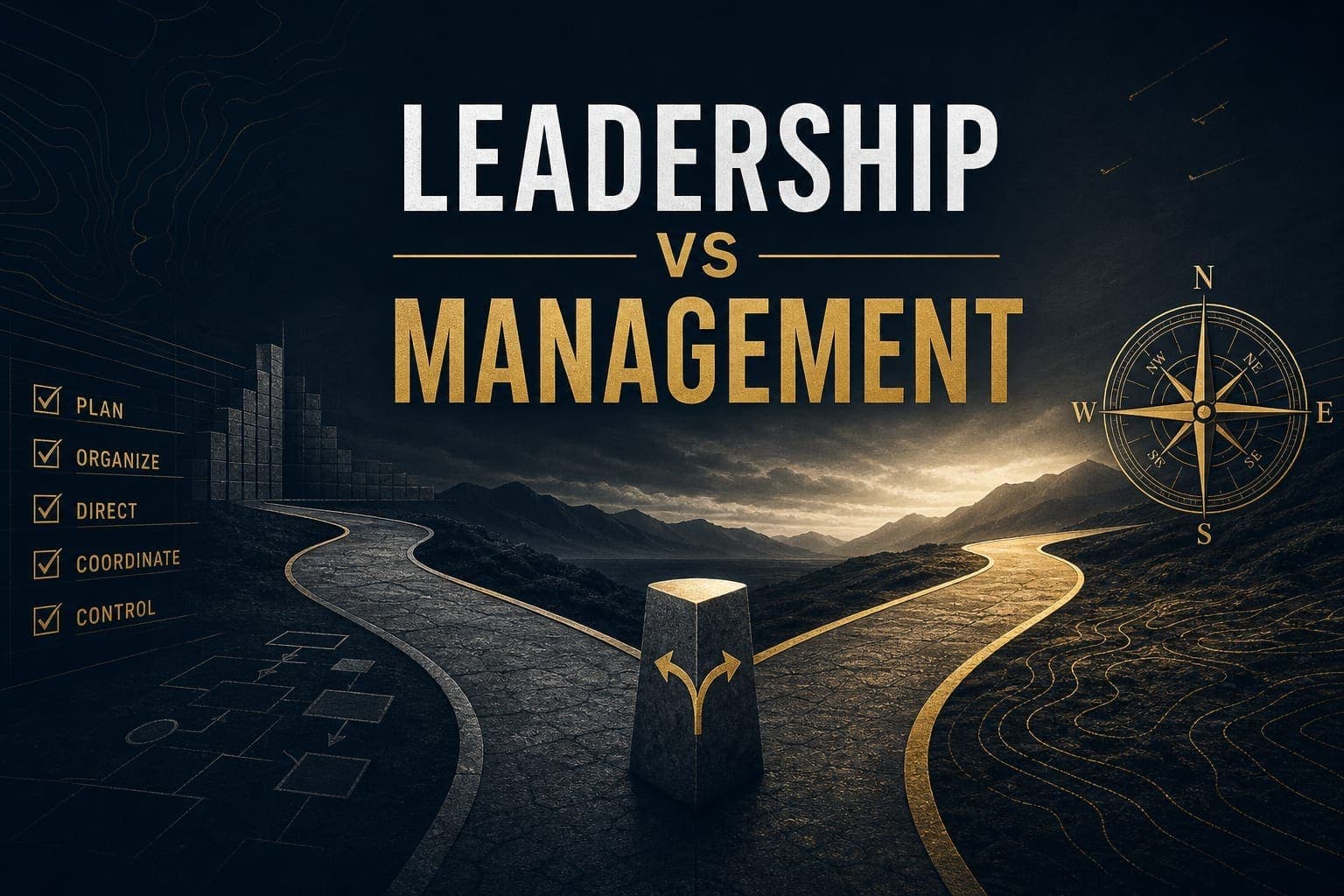
You're not failing. You're doing two jobs and getting credit for neither.
Meetings produce updates, not decisions. Your boss doesn't see the full picture—you do. And it's exhausting.
If you've said "I keep managing fires instead of leading" or "Nothing moves without me pushing it," you're not alone. Directors and VPs sit in the gap between management and leadership—and the org keeps rewarding you for the wrong one.
The gap: management vs. leadership
Management is accountability for tasks:
- Running the cadence, clearing blockers, reporting status.
- Keeping the machine moving when direction is unclear.
Leadership is accountability for decisions:
- Naming the call when no one else will.
- Setting direction that survives the next reorg.
- Building alignment that doesn't require you in every room.
You're senior enough to see what's broken. Not senior enough to force the org to fix it. So every unclaimed decision lands on you.
That is the leadership vs management trap—not a talent gap, a role gap. Related read: Decouple Management from Mentorship when your calendar blurs accountability lines.
Why senior managers get stuck
Three patterns show up in every sector:
- The boss defers. Strategy slides down; accountability stops at your level.
- The team waits. Without a clear call, everyone optimizes for safety—not speed.
- You become the bottleneck. Nothing moves without you pushing it.
This isn't a personality problem. It's a decision architecture problem. The system rewards consensus theater over decisive calls.
Decision fatigue: the hidden tax
Every postponed decision compounds Decision Debt:
- The same issue resurfaces every quarter because no one owned the root call.
- Options shrink as deadlines close—you're choosing between bad and worse.
- You second-guess because choices aren't anchored to a clear framework.
If you recognize "I'm the one making every call and I'm exhausted"—you're paying interest on decisions someone else should have made weeks ago.
Decision fatigue in executive leadership isn't burnout from too many choices. It's burnout from carrying choices that were never yours to own alone.
Restore decisiveness you already have
You don't need to learn leadership from scratch. You need to restore the clarity and decisiveness you already know you should have.
The EDGE framework gives you:
- A repeatable system for high-stakes calls—not winging it in the next steering committee.
- Language to get alignment fast when stakeholders defer.
- A way to close decision debt before it becomes portfolio drag.
This isn't motivational fluff. It's the same discipline that runs $500M+ portfolios and military operations—adapted for corporate friction.
Split the job on paper
For one week, log every hour as management (tasks, reporting, coordination) or leadership (decisions, direction, accountability). Most directors discover they're 80% management—and wonder why strategic work never sticks.
Leadership hours should produce dated moves with owners. Management hours produce status. Both matter; only one changes the trajectory.
When the portfolio needs an operator
If your pain is enterprise-scale—roadmap drift, program recovery, board misread of risk—personal productivity won't fix it. For a keynote or workshop, see Speaking & Partnerships. For your own next call, ask Arty.
Score personal vs organizational drag with the Leadership Assessment before picking a lane.
What to do next
- Name one decision you've been carrying for someone else this week.
- Run the Leadership Assessment — score where deferred clarity is compounding.
- Read Volume 1 if you want the full framework on your own timeline.
Next step: Take the Leadership Assessment · Get the Book
Operational next steps
Career friction is rarely a skills gap—it is a decision architecture gap. Name the move you have avoided (role change, hard conversation, portfolio bet) and date it. Use the Leadership Assessment to see if deferral is compounding. Read Volume 1 for self-led framework work, or start a Speaking & Partnerships conversation when collaboration is the right next step.
Was this piece useful?
Related dispatches
Next steps
Continue with what fits this essay
- ModelExplore the EDGE Decision Matrix modelA weighted scoring frame that turns fuzzy forks into explicit trade-offs before politics or fatigue takes the wheel.Continue →
- ToolApply with an ToolInteractive worksheet or diagnostic from this topic.Continue →
- AssessmentTake the Leadership AssessmentSeven questions — score Decision Debt and get a journey recommendation.Continue →