Part of a series
Leader's Blueprint
“Stop promoting your best producer into your worst manager.”
Career pillar
Leading Is Not Scheduling: What TPMs and Product Managers Actually Do
Most orgs confuse management, leadership, and administration. What TPMs and Product Managers actually own—and why it matters.
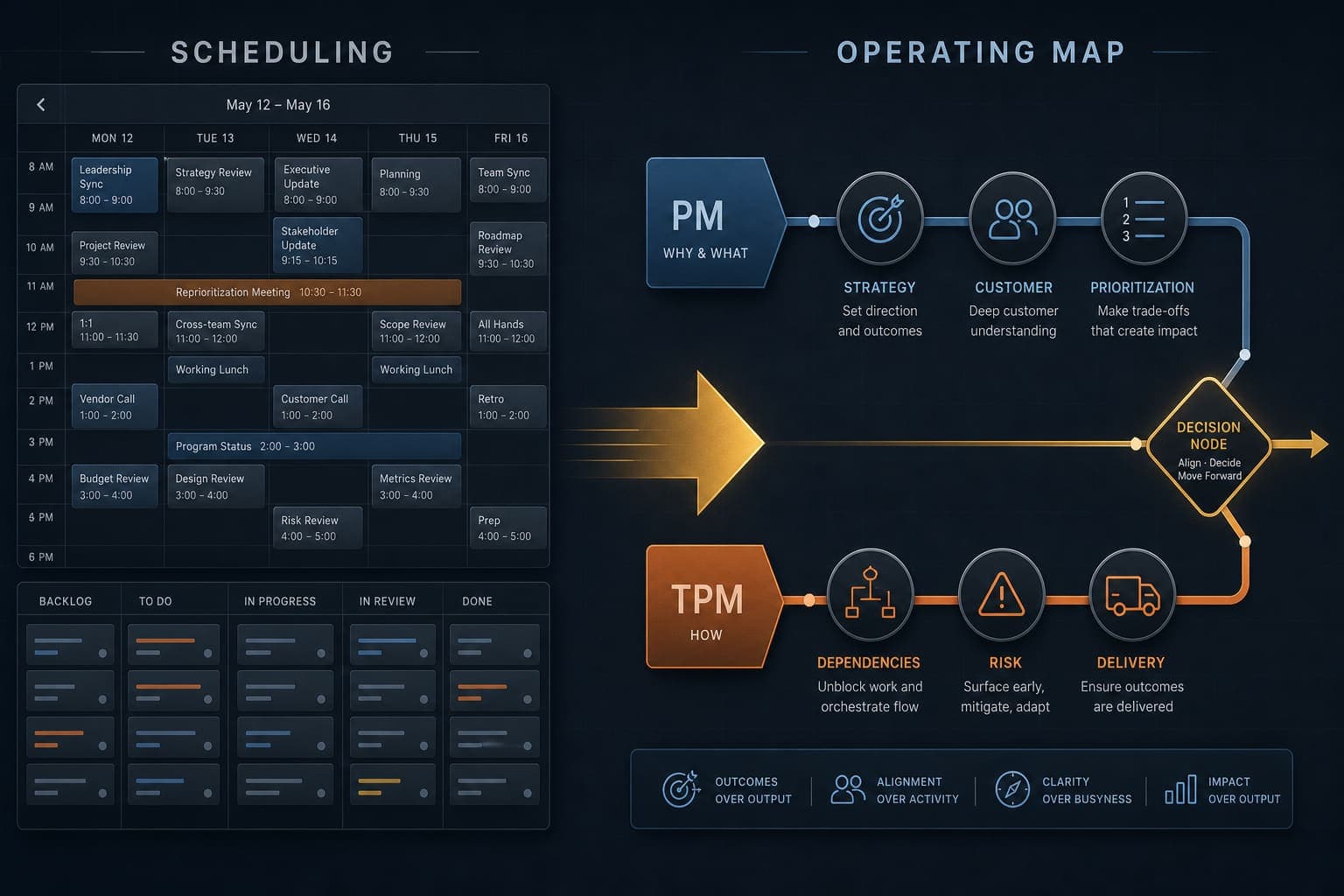
Caption: If your mental model of TPM or PM work starts with a calendar invite, you are paying for administration and calling it leadership.
There is a persistent, expensive confusion in most organizations about the difference between managing and leading—and it shows up most painfully in how companies misunderstand two of their highest-leverage roles: the Technical Program Manager and the Product Manager.
If your first image of either role is someone maintaining a backlog, booking rooms, and generating status reports, read on. That image is wrong, it is costing your company, and it is probably driving your best people out the door.
Management and leadership are not the same thing
This is not a business-book cliché. Confusing the two is structural Decision Debt: you defer the hard org-design choice until retention and delivery pay the interest.
Management is systems, process, and execution. A manager allocates resources, tracks progress, removes process blockers, enforces accountability, and keeps the machine running as designed. Management is present-tense: Are we doing this right, right now? Necessary. Valuable. Underrated.
Leadership is direction, influence, and judgment. A leader defines where the machine should go, creates conditions for others to do their best work, and makes calls when no process can tell you what to do. Leadership is future-tense: Are we doing the right thing—and building toward something worth building? Leadership is not a title. It is behavior.
You can manage without leading, and lead without managing. A staff engineer with no direct reports can lead a team through a technical crisis. A VP with fifteen reports can spend every day reacting to inbound and never set direction.
Organizations need both. They tend to reward leadership and staff for management—especially in program and product. The result: roles asked to lead, evaluated on whether the weekly update was on time.
What separates great programs from failed ones is almost never the polish of the status deck. It is the quality of judgment, relationships, and decisions made by the people driving them.
What a Product Manager actually does
The PM owns why and what—not how (engineering) or when (program). The PM is the customer’s proxy in the building: accountable for solving a real problem for a real person in a way that serves the business.
Done well, this is strategy, not coordination.
A PM worth the title spends time on:
- Product strategy grounded in customer insight, market dynamics, and business model—not a roadmap theater deck. A roadmap is an artifact. Strategy is a set of bets about where value lives.
- Ruthless prioritization—saying no to good ideas for great ones, and owning the tradeoff. Every yes is a no somewhere else.
- Signal synthesis—turning users, data, sales, support, and market noise into conclusions, not inbox forwarding.
- Translation up, down, and sideways—technical complexity for executives; business context for engineers—without condescension.
- Influence without authority—accountability for outcomes you cannot order into existence.
A PM is not primarily an order taker, feature factory, Confluence maintainer, Scrum Master, or backlog groomer. Those can be real roles. They are not the PM role. Requirement-taking PMs ship what stakeholders asked for. Strategic PMs tell a senior leader when the thing they want is not what the customer needs.
What a Technical Program Manager actually does
If the PM owns why and what, the TPM owns how and when—but not as a scheduler.
Conflating a TPM with an administrative project coordinator is like conflating a structural engineer with someone who orders steel.
A TPM sits at the intersection of technical depth and program-level thinking. Their job is to make complex, cross-functional technical programs succeed—which means seeing real risks, building alignment across teams that do not share a reporting line, and making tradeoffs when scope, schedule, and resources collide (they always do).
A TPM at full capacity spends time on:
- Program structure—dependency models with risk surfaces identified, not color-coded timelines alone.
- Technical risk management—knowing what “we’ll figure it out” actually means, and when optimism is lying.
- Clarity in ambiguity—surfacing mismatched definitions of “done” and driving a decision.
- Influence across boundaries—leverage through trust and competence, not headcount.
- Program health with integrity—no green-washing, no panic theater. Context decision-makers can act on.
- Escalation with judgment—knowing what must surface now versus what the working team can own.
The best TPMs are often people who could have been staff engineers or engineering managers. They chose connective tissue over single-team depth—not because they lack technical fluency, but because that is where the leverage is. They are peers of engineers, operating in a different domain.
TPM vs PM: where they differ and overlap
Dimension
Product Manager
Technical Program Manager
Dimension
Product Manager
Technical Program Manager
Dimension
Product Manager
Technical Program Manager
Dimension
Product Manager
Technical Program Manager
Dimension
Product Manager
Technical Program Manager
Dimension
Product Manager
Technical Program Manager
| Dimension | Product Manager | Technical Program Manager |
|---|---|---|
| Primary question | Are we building the right thing? | Are we building the thing right? |
| Core currency | Customer insight, market strategy | Technical fluency, cross-functional execution |
| Accountability | Product outcomes—adoption, retention, revenue | Program outcomes—delivery, quality, risk |
| Leverage | Roadmap, prioritization, requirements | Structure, dependencies, alignment |
| Stakeholder altitude | C-suite, customers, go-to-market | Engineering, architects, cross-functional leads |
| Risk focus | Market risk, product-market fit | Technical risk, execution risk, integration |
Both overlap on strategic judgment and influence without authority. Both live or die on communication quality and trust.
Failure modes: collapse the roles (PM runs the program; TPM defines product direction) or narrow them until neither can do the job. Pair this essay with First Team & cross-functional teams and Decouple management from mentorship—org design is the container these roles run in.
What these roles are not—and why it matters
Neither the TPM nor the PM is primarily an administrator.
Wiki updates, slide decks, meeting logistics, and notes matter. Someone has to do them. They are not the center of gravity of the role.
When you hire a TPM to be a project coordinator, you get coordination—not risk management, technical judgment, or cross-org alignment. When you hire a PM to be a business analyst, you get requirements documents—not product strategy or the nerve to say we should not build that.
The organizational cost:
- Wrong hires—process comfort over judgment
- Right people leave—experienced TPMs and PMs will not stay in scheduler costumes
- Worse decisions—no judgment layer between strategy and execution
- Avoidable program failure—risks visible to someone who was never empowered to surface them
This is org design, not title prestige. If you want leaders in these seats, define, compensate, and evaluate them that way.
Leadership without authority
Both roles are leadership without authority—arguably the hardest form.
Leading people who report to you has formal mechanisms. TPMs and PMs have almost none. They lead through credibility, clarity, and relationship. They must make people who do not report to them align on a shared direction—and keep earning the right to be heard in rooms where they have no formal standing.
That smoothness when programs “just work”? Not luck. Craft. And it disappears fast when the role is bureaucratized.
For portfolio-scale forums where these roles should close—not decorate—see Execution drag & governance. For craft careers that should not be forced into people-management to get paid, see The accidental manager & principal craft track.
One action
In your next staff or product review, ask one question:
“Are we evaluating this TPM or PM on judgment and outcomes—or on calendar hygiene and status theater?”
If the honest answer is hygiene, name one metric you will change this quarter: escalation quality, decision closure rate, risk surfaced before integration—not slides shipped.
The audit question
Think of the best TPM or PM you have worked with. What did they do that never showed up on a status report—but without which the program would have failed?
Name it. Then ask whether your current role definition would let someone do that work again.
Run it: Executive Diagnostic · Speaking & Partnerships
Related: Leader's Blueprint (start here) · Shadow AI governance
Was this piece useful?
Related dispatches
Next steps
Continue with what fits this essay
- ModelExplore the EDGE Decision Matrix modelA weighted scoring frame that turns fuzzy forks into explicit trade-offs before politics or fatigue takes the wheel.Continue →
- ToolApply with an ToolInteractive worksheet or diagnostic from this topic.Continue →
- AssessmentTake the Leadership AssessmentSeven questions — score Decision Debt and get a journey recommendation.Continue →