Self pillar
Stability Isn't Positivity: How to Hold the Floor When Nothing Responds to You
When work, family, and the standard go haywire at once, positivity fails because it is a feeling being asked to do a system's job.
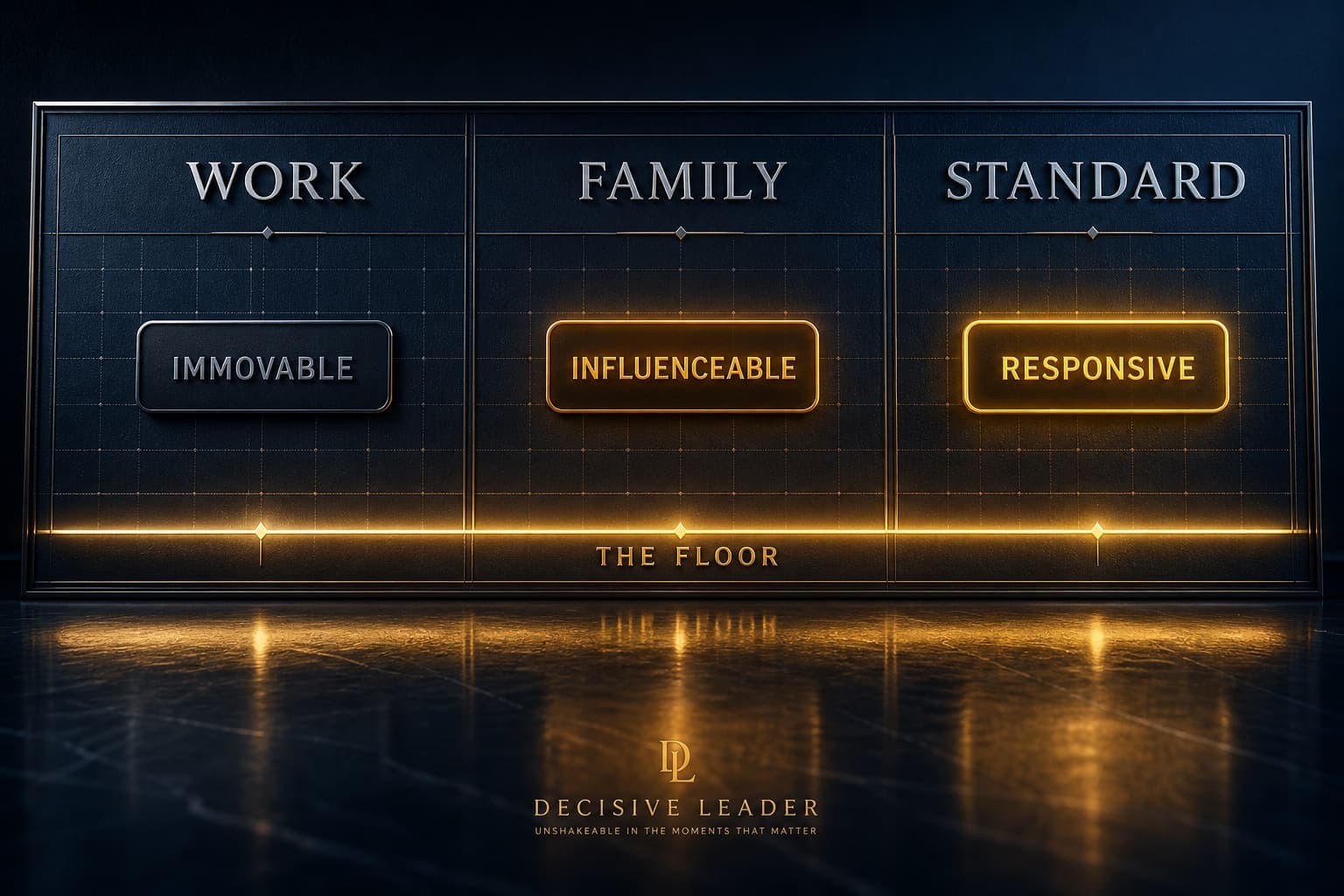
Caption: Stability is unbroken — not positive. The floor holds when the fronts do not.
I am writing this from inside the week, not from the far side of it.
Three fronts went sideways at once. At work, a delivery problem became a blame problem — people declining to own their calls and reaching for a name to hand them to instead. At home, time with my kids got reshuffled at the last minute, and there is no version of that where I get the hours back. And the standard I am measured against as an officer changed, so now there is a clock on my body that I did not set.
One word for it: draining.
None of it resolved by the time I wrote this. That is the point. Most writing on this subject arrives with the storm already past and a bow on it, which is why it is useless on a Tuesday. So here is the argument from inside: stability is manufactured, positivity is not the mechanism, and the mood is a byproduct that shows up late. There is a protocol at the bottom. Run it tonight if you need it tonight.
The three fronts have the same shape
It looks like three unrelated problems. It is one pattern wearing three costumes.
In every case, somebody else's unowned decision became my load. Coworkers decline to own an outcome, and the accountability has to land somewhere, so it lands on whoever is still standing there. A schedule changes on short notice, and the cost transfers to the person with less say. An institution revises a standard, and the compliance work transfers to the individual on a compressed timeline.
I named this mechanic in The Four Surrenders and called it the Accountability Shuffle. I wrote it about AI systems. I was wrong about the scope. AI industrialized the pattern; it did not invent it. Humans have run the Shuffle on each other for as long as there have been consequences to hand off, and analysis paralysis is what it looks like when a whole org does it at once.
This matters because it locates the drag. It is not the volume of bad news. It is that each handoff spawned real decisions I have not made yet — whether to keep absorbing calls that were never mine, what to do with the time I do get, how hard to push on a clock I resent. Unmade decisions accrue interest whether the subject is a roadmap or your life. That is Decision Debt on adversity instead of on delivery, and the felt symptom is the rut: flat, stuck, watching. Same compounding I mapped in Losing Thursday, different collateral.
One correction before the framework, because flattening it would be dishonest: the three fronts are not equivalent. Two are friction. One is loss. Finger-pointing is infuriating and a deadline is a deadline, but missing time with your children because someone moved it is grief, and grief does not respond to optimization. If you are reading this with your own version of that in the third slot, do not let a framework talk you out of feeling it.
Why "stay positive" fails as an input
Positivity is an output being conscripted to do a system's job.
Asking yourself to feel good about a week that is objectively going badly costs energy you do not have. It does not survive company either — people can tell, and performing fine for an audience is a second tax on top of the original problem. Worst of all it sets a win condition you cannot hit, so every hour you do not feel positive reads as personal failure stacked on circumstances that were never yours.
I have argued for years that architecture beats hustle and that protocols beat spa days. That argument does not stop applying when the subject is morale. If anything, morale is where willpower is least reliable, because the thing you are trying to will is a mood.
Reset the win condition: stable, not positive
Stability is not a synonym for positive. Stability means unbroken — operational and honest at the same time.
That is achievable on the worst day of a bad month. Positive is not. You can hold a standard, keep your temper, tell the truth about how it is going, and show up where you said you would, while feeling exactly as bad as the situation warrants. That is a win. Log it as one. It is the same Anchor Effect I have written about for negotiation, turned inward.
When your usual coping mechanism is the thing you just lost
Here is the part I have not seen written honestly anywhere.
Most of us have one reliable comfort. For me it has always been food — a good meal at the end of a hard day, and the day gets filed as survivable. This month that door is closed by the clock on the standard. So the coping mechanism went away in the same week the load went up.
That is its own distinct loss and it deserves to be named rather than absorbed. When the comfort disappears, the load does not become lighter; it becomes unbuffered. And the honest news is that nothing replaces it one-for-one. Anyone selling you a clean swap has not done it.
What partially works are small returns you can actually collect the same day: movement that is not training and carries no performance number attached to it, one real conversation with someone who knows the situation, the work record kept current, sleep protected like a deliverable. Each one is a fraction of what the old comfort paid out. Collected daily, they cover more than you would expect, because what the comfort was really providing was evidence that the day could still end well. That evidence is reproducible. The specific form it took is not sacred.
The mechanism: proof that your actions still connect to something
Morale is downstream of proof of agency. When your large levers are jammed — a culture, an institution, another adult's choices — you lose the daily feedback that your actions produce outcomes. That absence, not the bad news, is what produces the flatness.
So you rebuild the proof on smaller levers with same-day feedback. First sort the fronts, because almost all wasted effort in a haywire month is force applied to the immovable column.
Responsive — moves when you push, today. Influenceable — moves eventually, indirectly, if you are patient and specific. Immovable — does not move, no matter what you spend on it.
Most people misfile the middle column in one of two directions. Call it control and you burn out. Call it immovable and you go passive. The middle is where the work is. If you want the weighted version of this sort, run the Decision Matrix instead of doing it in your head.
Then act by column, not by how loud each front is.
On the influenceable front — convert emotion into record. I cannot make anyone own their mistakes. I can keep an unglamorous, contemporaneous record: what was decided, by whom, on what date, with what open question. Not to win the blame game. To stop absorbing calls that were never mine. Documentation is the only armor available on that front and it works whether or not anyone else changes. It is governance instead of status theater, applied to your own exposure.
On the immovable front — grieve it instead of managing it. Name it out loud once, to a person rather than a notebook, then stop relitigating it internally twenty times a day. The relitigating is what drains the week. And do not let resentment about the change contaminate the hours you do get — that is the only part still in your hands, and being the anchor rather than the weather is the whole job when you are the parent in the room.
On the responsive front — protect it from becoming the dumping ground. This is the section I would have skipped five years ago and it is the one that matters most. When two of three fronts will not move, the one that does becomes the disposal site for every ounce of agency you cannot spend elsewhere. That is how a standard with a deadline turns into something punishing and improvised at exactly the moment your judgment is worst. Route it through the official channel — unit readiness and human-performance resources exist for this, and a supervised plan on a compressed timeline is not the same animal as a solo crash. Treat sleep and temper as constraints that do not get traded. They are precisely what the other two fronts are demanding of you.
What the Army taught me about morale
Nobody in command talks a unit into good morale. I have watched people try. It reads as theater inside ninety seconds.
Morale comes from functioning systems, standards held whether or not anyone is watching, and people who are fed, rested, and clear on what they own. It is a byproduct of the machine running. Leaders who understand that spend their energy on the machine. Leaders who do not spend it on speeches and then wonder why nobody believes them. Same reason leading through a redline is a protocol problem and not an attitude problem.
The same holds for one person in a bad month. You do not talk yourself into stability. You build the small machine and let the mood catch up.
The 14-Day Floor
Not a plan to fix three fronts. A floor: the minimum standard that survives the worst day of the month. Fourteen days because that is long enough to produce evidence and short enough to start when you are already tired.
- Sort the fronts. Write every live stressor into responsive, influenceable, or immovable. Ten minutes, on paper. Nothing else in the protocol works until the columns are honest.
- Set four non-negotiables. Deliberately unimpressive, small enough that a terrible Tuesday cannot take them. Mine: sleep protected, the work record current, the hours with my kids fully present instead of half-spent on resentment, the standard worked through the proper channel rather than improvised at 5 a.m. A floor you can only hold on a good day is not a floor, it is a goal.
- Bank one proof of agency daily. One action on the responsive column with same-day feedback, logged where you can see it. The log is the point — the flatness comes from lost evidence, so the evidence has to be visible.
- Clear one deferred decision daily. Smallest one first. Cheap, reversible, written down. You are paying down the Decision Debt the situation created rather than waiting for the situation to resolve first. It will not.
- Stop force on the immovable column. Once per day, catch yourself relitigating and stop. Not suppression — redirection to column one.
- Review weekly, not daily. Two Sundays, twenty minutes each, using the 1% Sunday format. Did the floor hold, which non-negotiable is failing, what changed externally. Do not assess a floor in the middle of a Wednesday.
- Recommit or revise at day 14. Adjust the four, then run it again. There is no graduation ceremony.
What actually happens if you run it
Here is the promise, sized honestly.
The first three or four days will not feel better. What changes early is the noise — the number of open loops rattling in the background drops, because you are deciding again instead of waiting. Around the end of the first week the flatness starts lifting, not because circumstances improved but because you have accumulated seven days of evidence that your actions still land somewhere. By day fourteen the fronts may be exactly where they were, and you will be measurably harder to knock over.
That is the rut breaking. It does not break because the storm stopped. It breaks because the floor outlasted it. And once you are stable, the situation gets to move on its own schedule while you stay operational, which is the only position from which anything good has ever happened to me.
The mood comes back after. Every time. Just never first, and never on demand — which is exactly why chasing it directly is the thing that keeps people stuck.
Where this leaves the week
Nothing above resolved anything. The blame culture at work is still there. The hours with my kids are still gone. The clock is still running.
The floor held. On a week like this one, that is not a consolation prize. That is the entire scoreboard.
If the flatness is not lifting regardless of what you do — sleep gone, nothing landing, weeks not days — that is a different problem and a protocol will not touch it. Talk to someone qualified. For service members and families, Military OneSource (800-342-9647) and your unit chaplain are both confidential doors that do not route through your chain of command. In the U.S., 988 is available any hour.
See also: The Capacity Matrix: Saying No Without Guilt · Johnny's Thursday · The Self Pillar · Disciplined Sovereignty · The Perimeter Strategy · Adapt phase
Operational next steps
Run the Leadership Assessment — seven questions for your Decision Debt score, pillar read, and journey recommendation. For the full reset-protocol volume, start with Life Ops (Vol. 3) — capacity defense, recovery without shame spirals, and what to run when the plan breaks.
Tools: Decision Debt app · Capacity Matrix · EDGE Framework one-pager (PDF)
If this essay landed, pick one decision you deferred this week and write the call in a single sentence. When the room—not your head—is the bottleneck, explore advisory. Subscribe to The Bridge for weekly leadership briefs.
Was this piece useful?
Related dispatches
Next steps
Continue with what fits this essay
- ModelExplore the Decision Debt modelThe compounding cost of decisions delayed, avoided, outsourced, or surrendered: a high-interest loan against the future.Continue →
- EDGE ToolApply with an EDGE ToolInteractive worksheet or diagnostic from this topic.Continue →
- AssessmentTake the Leadership AssessmentSeven questions — score Decision Debt and get a journey recommendation.Continue →