Career pillar
AI Won't Get You the Job. Your Judgment Will.
How to run an AI-assisted job search that gets you in the room — without sounding like everyone else using the same tools.
How to run an AI-assisted job search that gets you in the room — without sounding like everyone else using the same tools.
Right now, two armies are firing AI at each other across the hiring line.
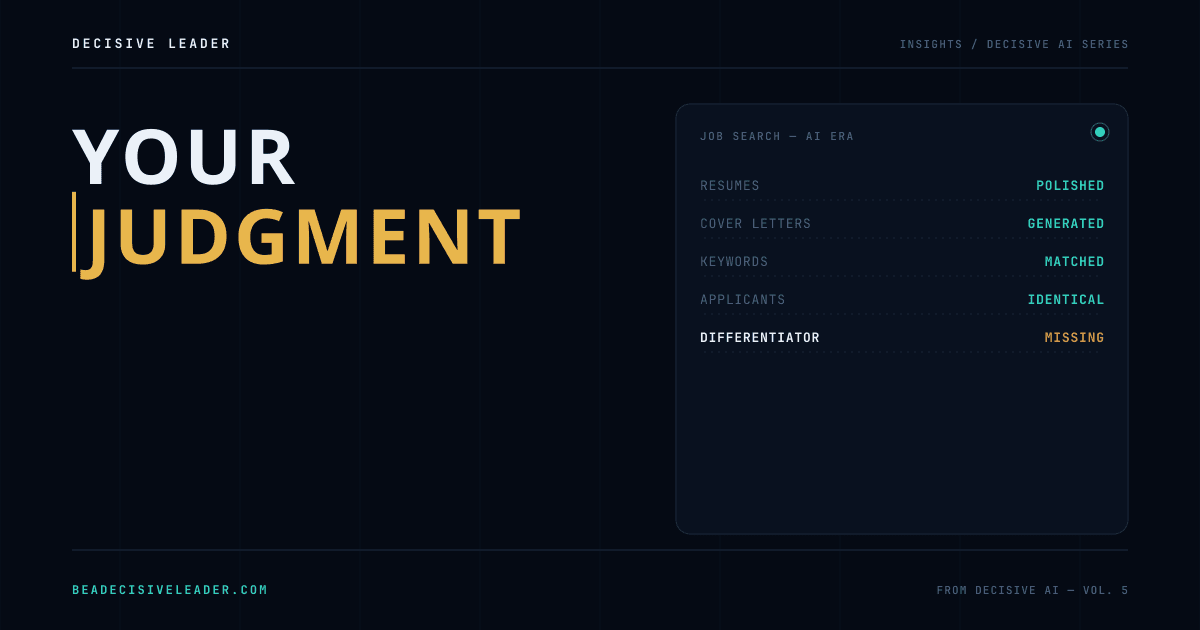
On one side, candidates are generating resumes, cover letters, and outreach at a scale that would have taken weeks a year ago. On the other, employers are deploying AI to screen, rank, and filter that flood before a human ever lays eyes on it. Application volume has never been higher. The signal inside it has never been lower.
Most people fall into the same trap: they treat AI as a replacement for the work instead of leverage on it. They let the model write the entire resume, fire off two hundred applications in a weekend, and then wonder why the inbox stays quiet. The rare candidate who uses AI as an engine — but keeps a hand on the wheel — is the one who gets the call.
That distinction is the whole game now, and it's why I wrote Decisive AI. The framework at the center of the book, the A.R.C. Protocol — Architect, Reserve, Calibrate — was built for exactly this kind of high-stakes, AI-saturated decision environment. A modern job search is one of the best places to run it.
Architect: build a search, not a scramble
Most job searches are reactive. You see a posting, you panic-apply, you repeat. AI makes that reactive loop faster, which means it makes the wrong thing faster.
Architecting means deciding, up front, what your search actually is before you touch a single application. Who are you targeting — which titles, which industries, which size of company? What does a real "yes" look like, and what are you willing to walk past? What parts of this process are repetitive enough to delegate to a machine, and what parts demand you?
This is where AI earns its keep as infrastructure, not just a writing tool. Build yourself a system: a master narrative document with your real wins, metrics, and stories, fed into your AI so every output is grounded in you instead of generic filler. A target list. A repeatable way to decode a job description into what the role actually wants. I went as far as building my own AI search co-pilot — but you don't need to code anything. You need to decide what the system is before you let it run.
The Four Surrenders concept from the book lives here: every task you hand to AI should be a conscious surrender, not a reflexive one. Delegate the grind. Keep the judgment.
If you'd rather not build that scaffolding from scratch, two of the EDGE Tools on the site do it for you. The Decision Design Brief Generator frames your search as a decision before you act on it, and the AI Intelligence Script turns any job description into a research and interview-prep brief in minutes.
Reserve: know where the Judgment Line is
This is the move almost everyone misses.
In the A.R.C. Protocol, Reserve means holding your human judgment back for the decisions that actually matter — not spending it on everything, and not surrendering it where it counts. Every AI-assisted process has a Judgment Line: the point where the machine should stop and you must take over. Cross it in the wrong direction and you pay for it.
In a job search, the Judgment Line sits exactly where humans are doing the evaluating. The resume that a person finally reads. The interview. The "why you, why now" story. The referral conversation. AI can draft, structure, and accelerate everything up to that line. It cannot be you on the other side of it.
I learned this the hard way with my own resume. At one point it had quietly drifted into that smooth, confident, AI-generic register — technically polished, completely forgettable, and exactly the kind of thing screeners and humans alike have learned to distrust. AI-written resumes are getting flagged precisely because they all sound the same. I rebuilt mine around real titles, real dates, and real outcomes, in my own voice. The lesson generalizes: use AI to sharpen your material, never to manufacture it. The second a reader senses they're talking to a template instead of a person, you've lost the thing the whole process exists to establish — trust.
Reserve your voice for the moments people judge you. Let AI carry the rest.
Two tools help you find that line on purpose. The Four Surrenders Self-Diagnostic shows you which tasks you're handing over by default versus by choice, and the Decision Rights Charter Builder makes you name who — or what — owns each call in your process before you outsource it.
Calibrate: read the signal, tune the system
A job search throws off data constantly, and most people ignore all of it. Calibrating means treating every response — and every silence — as a signal to adjust.
Are a particular type of role replying and another going dark? That's information about fit and positioning. Is one version of your outreach getting responses while another vanishes? Tune toward the one that works. Are you getting screens but not second rounds? The problem isn't your resume — it's something happening at the Judgment Line, and no amount of better AI drafting will fix it.
AI is genuinely useful here as an analyst. Feed it your tracking data and ask it what patterns it sees. Have it pressure-test your interview stories and play a skeptical hiring manager. But the calibration decisions — what to change, what to kill, where to push — stay yours. The system runs; you steer.
The Trust Calibration Scorecard is built for exactly this. It scores how much weight an AI output has earned before you act on it, so you're tuning your trust deliberately instead of by gut.
A few tricks worth stealing
A handful of concrete moves that put all of this into practice:
- Use AI to research, not just to write. Decode the job description into what the role actually wants, pull intel on the company and your interviewers, and surface the questions they're likely to ask. This is where AI quietly creates the most edge — and almost nobody uses it this way.
- Build a master narrative once. Drop your real accomplishments, metrics, and stories into a single document and feed it to your AI as context. Now every tailored resume and message is grounded in your truth instead of inventing a generic one.
- Tailor with AI, finish by hand. Let the model adapt your material to each role, then do a final human pass and read it out loud. If it doesn't sound like you, it isn't ready.
- Reverse-engineer the keywords, keep them honest. AI is great at mapping your experience to the language a screening system expects. Use it — but never let it claim something you can't back up in the room.
- Make AI your sparring partner before interviews. Run mock questions, defend your decisions out loud, and have it poke holes in your stories. Walk in already battle-tested.
- Personalize the parts that matter. Draft outreach with AI if you want, but write the first two lines yourself. That's the part a human actually reads before deciding whether to keep going.
- Track everything and let the data lead. What you measure, you can calibrate. What you don't, you repeat blindly.
Now your turn
These are the moves that have worked for me — but the people running their own AI-assisted searches right now are figuring things out in real time, and some of the sharpest tricks never make it into a book.
So I want to hear yours. What's actually moved the needle in your search? A prompt you keep reusing? A way you've gotten past the screen and in front of a human? A mistake you'd warn someone else away from? Where's your Judgment Line — the thing you refuse to hand to AI no matter how much time it would save?
Drop it in the comments. The best ideas in this space aren't coming from the top down. They're coming from people in the trenches, comparing notes. Let's build the playbook together.
The bottom line
AI has not made the job search easier. It has made it louder. The candidates who win in this environment aren't the ones generating the most output — they're the ones who know exactly what to hand to the machine and exactly where to take the wheel back.
That's the entire premise of Decisive AI: the advantage was never the tool. It's the judgment about how to use it. Architect the system. Reserve your judgment for the line that matters. Calibrate as you go.
AI can get your application seen. Only you can get yourself hired.
Put the protocol to work
Every framework in this piece has a tool behind it, and they all live in one place: the EDGE Tools. Architect your search with the Decision Design Brief Generator and AI Intelligence Script, find your Judgment Line with the Four Surrenders Self-Diagnostic and Decision Rights Charter Builder, and tune as you go with the Trust Calibration Scorecard.
Not sure where to start? Run the Decision Debt Diagnostic first — it's the fastest way to see where indecision is quietly costing you, in your search and everywhere else.
Adapted from Decisive AI, Vol. 5 of the Decisive Edge series. Explore the books → For more on the A.R.C. Protocol and the Judgment Line, follow Decisive Leader on LinkedIn. Join The Bridge for weekly deployable protocols.
Was this piece useful?
Related dispatches
Next steps
Continue with what fits this essay
- ModelExplore the Four Surrenders modelFour failure modes where smart teams quietly offload judgment to machines: Oracle Trap, Automation Bias, Accountability Continue →
- EDGE ToolApply with an EDGE ToolInteractive worksheet or diagnostic from this topic.Continue →
- AdvisoryExplore Charter Sprint advisoryWhen governance rollout needs facilitated alignment across legal, engineering, and business.Continue →