Part of a series
Decisive AI & Governance
“The machines have the answers. You have the call.”
Career pillar
Who Decides When the AI Underwrites? The Decision Rights Charter Every Insurance AI Rollout Is Missing
Who decides when AI underwrites or adjudicates? Delegate, Augment, Reserve for insurance AI—with a charter regulators and ops can hold accountable.
General version (all industries): Who Decides? The Three-Tier Charter Every AI Rollout Is Missing
Here's a sentence that should alarm every carrier deploying AI:
Most insurers adopting AI never explicitly decide which decisions the model gets to make.
We decide on the vendor. The budget. The implementation timeline. The model-risk review. The filing. Then we switch the thing on and let the boundary between machine decisions and human decisions get negotiated by accident — one workflow at a time, by whoever happens to be configuring the rules engine that day.
It's like hiring a brilliant new chief underwriter, never defining the role, and then acting surprised when they're quietly setting appetite eighteen months later.
In a regulated industry, that drift isn't just operational risk — it's the kind of thing a market-conduct examiner asks about. The fix is a discipline I call Decision Rights, and it sorts every decision in your operation into one of three tiers.
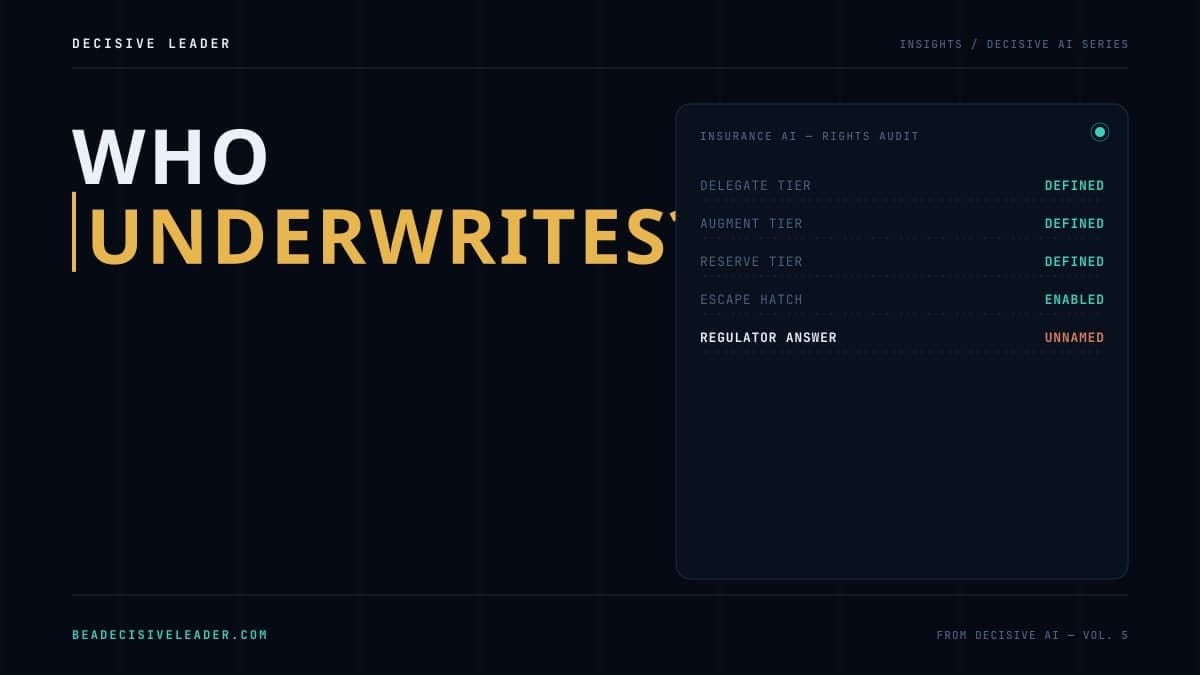
Tier 1: DELEGATE — the machine decides, humans audit
Delegate-tier decisions share three traits: they're reversible, low-stakes individually, and high-volume. Routing a first notice of loss to the right queue. Flagging a claim for SIU review. Straight-through processing of small, reversible claims within preset limits. Triaging submissions against appetite. If the model gets one wrong, you catch it, fix it, and move on.
Delegating these isn't surrender — it's strategy. Every hour an adjuster or underwriter spends on a call the machine can make safely is an hour stolen from the calls only they can make.
Two rules keep Tier 1 honest. First, sample audits: humans review a random slice of the model's calls, because unwatched systems drift — and drift in rating or claims handling is how you end up explaining a disparate-impact pattern you never intended. Second, escape hatches: any policyholder or producer can pull a decision up a tier. The insured who says "I want a human" gets one. Always.
Tier 2: AUGMENT — AI drafts, a named human decides
This is the default tier for consequential calls, and it should be the biggest tier in your charter. The model does what it does best: gathers, scores, surfaces options at speed. Then a named human does what only humans can do — weighs it against context, exposure, and fairness, and makes the call with their name on it.
The operative word is named. Augment-tier decisions have a single accountable owner, and that owner must be able to defend the decision from a blank whiteboard, no model in the room. In insurance that isn't a metaphor: if an underwriter can't explain a decline without pointing at a score, you can't issue a defensible adverse-action notice — and you can't answer the regulator who asks why. If you can't explain it without the tool, you haven't decided. You've subscribed.
Tier 3: RESERVE — human-only; the machine may inform, never recommend
Some decisions should never carry an AI recommendation at all — not because the model couldn't produce one, but because the act of producing it contaminates the judgment. A recommendation is an anchor. Once the room has seen "the model suggests deny," every human thought gets measured against deny, and dissent starts to feel like arguing with math.
Reserve-tier in insurance includes: decisions that materially affect a person's livelihood or access to coverage, large-loss and potential bad-faith determinations, anything touching unfair discrimination or vulnerable policyholders, and the company-shaping strategic bets — entering a line, acquiring a book. Plus a catch-all worth memorizing:
Anything you must personally defend to a regulator, a policyholder, or a court.
If you'd be uneasy saying "the model recommended it" under oath, the decision was Reserve-tier all along. AI can still inform — pull the loss history, model the scenarios — but the synthesis, the weighing, and the recommendation stay in human hands from start to finish.
The three-question tier test
For any decision in front of you right now:
- Is it reversible? Can you unwind it without harming a policyholder or breaching a filing? If yes, it might be delegable. If no, climb a tier.
- Who answers for it? If you can't name the human — and an examiner asks "who decided this?" — you've found a problem in progress.
- Would I sign my name to it, in a market-conduct exam? If the thought makes you flinch, it's Reserve-tier.
What happens when you publish one
The first time a program lead publishes a charter, something unexpected tends to happen: half the political fights on the team simply evaporate. The friction was never really about the technology. It was unspoken anxiety over who actually owned what. The charter doesn't restrict anyone — it relieves everyone. People fight hardest in undefined territory. Draw the map, and the shooting mostly stops.
A governance note, because insurance lives and dies on it: AI's arrival tempts organizations to give the algorithm a letter on the RACI chart. Fine — let the model be Responsible or Consulted on plenty of rows. But the A never goes to the algorithm. Accountability requires someone who can be promoted, demoted, thanked, or fired — and someone a regulator can hold answerable. The day your RACI has an A with no heartbeat behind it, your governance is decorative.
Build yours before the tool builds it for you
You can stand up a first draft in an afternoon: list your highest-volume AI-touched decisions, sort each into Delegate, Augment, or Reserve, name an owner for every Augment and Reserve row, and write down the audit cadence for Tier 1. Then publish it, and defend it the way you'd defend any filing — because in this industry, sooner or later, you will.
Take the Decision Debt Diagnostic → — seven questions, instant read on where judgment is leaking.
Join The Bridge — 3 failures, 2 protocols, 1 strategy every Friday. Follow Decisive Leader on LinkedIn.
Was this piece useful?
Related dispatches
Next steps
Continue with what fits this essay
- ModelExplore the Four Surrenders modelFour failure modes where smart teams quietly offload judgment to machines: Oracle Trap, Automation Bias, Accountability Continue →
- EDGE ToolApply with an EDGE ToolInteractive worksheet or diagnostic from this topic.Continue →
- AdvisoryExplore Charter Sprint advisoryWhen governance rollout needs facilitated alignment across legal, engineering, and business.Continue →