Part of a series
Decisive AI & Governance
“The machines have the answers. You have the call.”
Career pillar
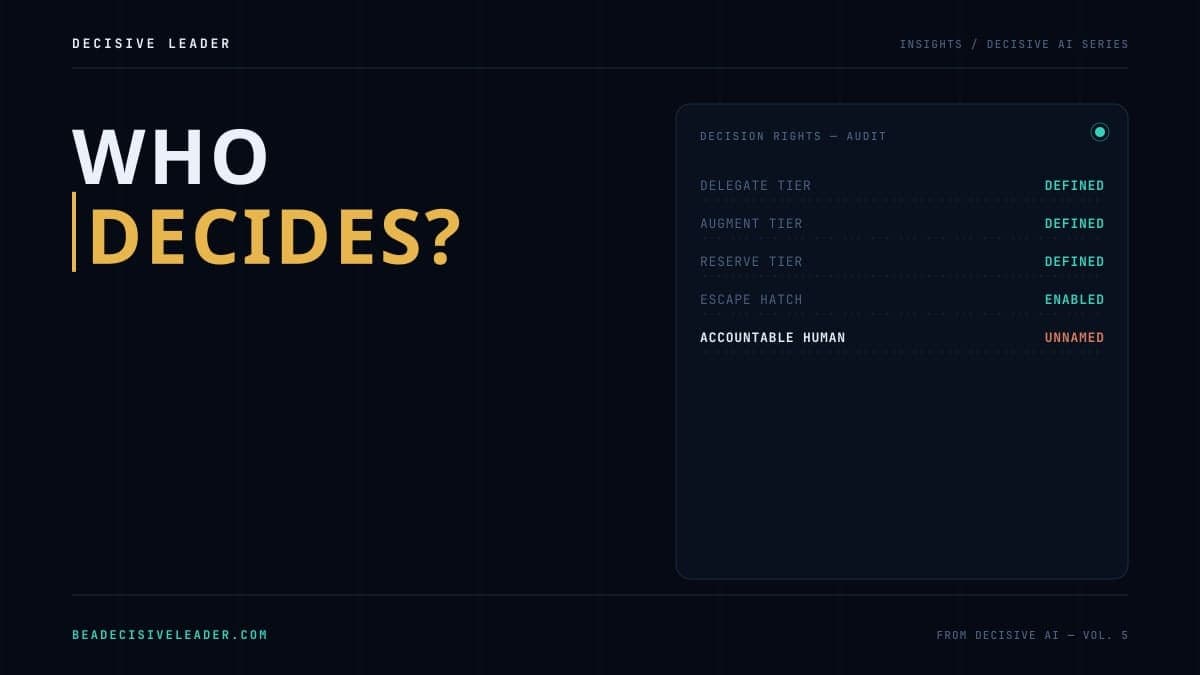
Who Decides? The Three-Tier Decision Rights Charter
Who decides when AI is in the loop? Delegate, Augment, Reserve, the three-tier Decision Rights Charter every rollout needs, with a free template and builder.
Insurance / InsurTech version: Who Decides When the AI Underwrites?
Here's a sentence that should alarm you:
Most organizations adopting AI never explicitly decide which decisions the AI gets to make.
They decide on the vendor. The budget. The rollout timeline. The training plan. The security review. Then they switch the thing on and let the boundary between machine decisions and human decisions get negotiated by accident — one workflow at a time, by whoever happens to be configuring the tool that day.
It's like hiring a brilliant new executive, never defining their role, and then acting surprised when they're running the company eighteen months later.
The fix is a discipline I call Decision Rights, and it sorts every decision in your world into one of three tiers.
Tier 1: DELEGATE — the machine decides, humans audit
Delegate-tier decisions share three traits: they're reversible, they're low-stakes individually, and they're high-volume. Routing a support ticket. Flagging a transaction for review. Reordering inventory within preset bounds. If the machine gets one wrong, you catch it, fix it, and move on.
Delegating these isn't surrender — it's strategy. Every hour your people spend on decisions a machine handles safely is an hour stolen from the decisions only they can make.
Two rules keep Tier 1 honest. First, sample audits: humans regularly review a random slice of the machine's calls, because unwatched systems drift. Second, escape hatches: any affected person can pull a decision up a tier. The customer who says "I want a human" gets one. Always.
Tier 2: AUGMENT — AI drafts, a human decides
This is the default tier for consequential calls, and it should be the biggest tier in your charter. The machine does what it does best: gathers, models, drafts, scores, surfaces options at speed. Then a named human does what only humans can do: weighs it against values, context, and consequences — and makes the call with their name on it.
The operative word is named. Augment-tier decisions have a single accountable owner, and that owner must be able to defend the decision from a blank whiteboard, no model in the room. If you can't explain it without the tool, you haven't decided. You've subscribed.
Tier 3: RESERVE — human-only; the machine may inform, never recommend
Some decisions should never receive an AI recommendation at all — not because the model couldn't produce one, but because the act of producing it contaminates the judgment. A recommendation is an anchor. Once the room has seen "the model suggests Option B," every human thought gets measured against B, and dissent starts to feel like arguing with math.
Reserve-tier includes: people decisions (hiring into leadership, promotions, lettings-go — anything where a human's life changes based on your judgment of their character), ethical calls (where the question is "what's right," not "what works"), strategic bets (the irreversible, company-shaping commitments), and a catch-all worth memorizing:
Anything you must personally defend to someone you respect.
If you'd be ashamed to say "the model recommended it" to that person's face, the decision was Reserve-tier all along.
For Reserve decisions, AI can still inform — pull the data, run the research, model scenarios. But the synthesis, the weighing, the recommendation stays in human hands from start to finish.
The three-question tier test
For any decision in front of you right now:
- Is it reversible? If yes, it might be delegable. If no, climb a tier.
- Who answers for it? If you can't name the human, you've found a problem in progress.
- Would I sign my name to it? If the thought makes you flinch, it's Reserve-tier — and it was never the machine's to make.
What happens when you publish one
In Decisive AI, when our test case Johnny publishes his first charter, something unexpected happens: half the political fights on his team simply evaporate. The friction was never really about the technology. It was unspoken anxiety over who actually owned what. The charter didn't restrict anyone — it relieved everyone. People fight hardest in undefined territory. Draw the map, and the shooting mostly stops.
One governance note for my PMO readers: AI's arrival tempts organizations to give the algorithm a letter on the RACI chart. Fine — let the machine be Responsible or Consulted on plenty of rows. But the A never goes to the algorithm. Accountability requires someone who can be promoted, demoted, thanked, or fired. The day your RACI has an A with no heartbeat behind it, your governance is decorative.
Build yours before the tool builds it for you
The full charter template — for your team, your program, or yes, your household — is in Decisive AI, Vol. 5 of the Decisive Edge series. Get the books →
Rolling out AI across an enterprise? The AI Command Governance Kit and the Decision Rights Charter tool take this from template to operating practice.
Join The Bridge — 3 failures, 2 protocols, 1 strategy every Friday. Follow Decisive Leader on LinkedIn.
Was this piece useful?
Related dispatches
Next steps
Continue with what fits this essay
- ModelExplore the Four Surrenders modelFour Surrenders are four failure modes where smart teams quietly offload judgment to machines: treating model output as Continue →
- ToolApply with an ToolInteractive worksheet or diagnostic from this topic.Continue →
- CollaborateSpeaking & PartnershipsWhen governance rollout needs facilitated alignment across legal, engineering, and business.Continue →