Part of a series
Decisive AI & Governance
“The machines have the answers. You have the call.”
Career pillar
The Human Veto: "It Wasn't Easy. It Was Rehearsed."
Every automated system needs one thing designed in before it goes live, and almost none have it: a real way for a human to say no.
Every automated system in your life needs one thing designed into it before it goes live, and almost none of them have it: a clearly defined way for a human to say no.
Not a workaround. Not a support ticket. Not an awkward conversation where someone justifies, hat in hand, why they think they're smarter than the platform the company just paid seven figures for. A real veto: named people, explicit authority, defined grounds, zero career risk for using it.
The most expensive silent sentence in business
In Decisive AI, I tell the story of Walt — a QA lead with twenty years of instincts — who watched a defective batch roll past because the AI detection system showed green, and he assumed the system outranked him. Nobody overruled Walt. Walt overruled Walt. The recall cost more than the detection system did.
Walt didn't fail because he lacked judgment. His judgment was perfect. He failed because his organization had never told him his judgment outranked the system — so in the moment, he assumed it didn't. The most expensive sentence in the AI era might be the one your best people say silently to themselves:
Who am I to argue with the math?
The veto exists to answer that question in advance: You. You are exactly who argues with the math. That's the job.
The four components
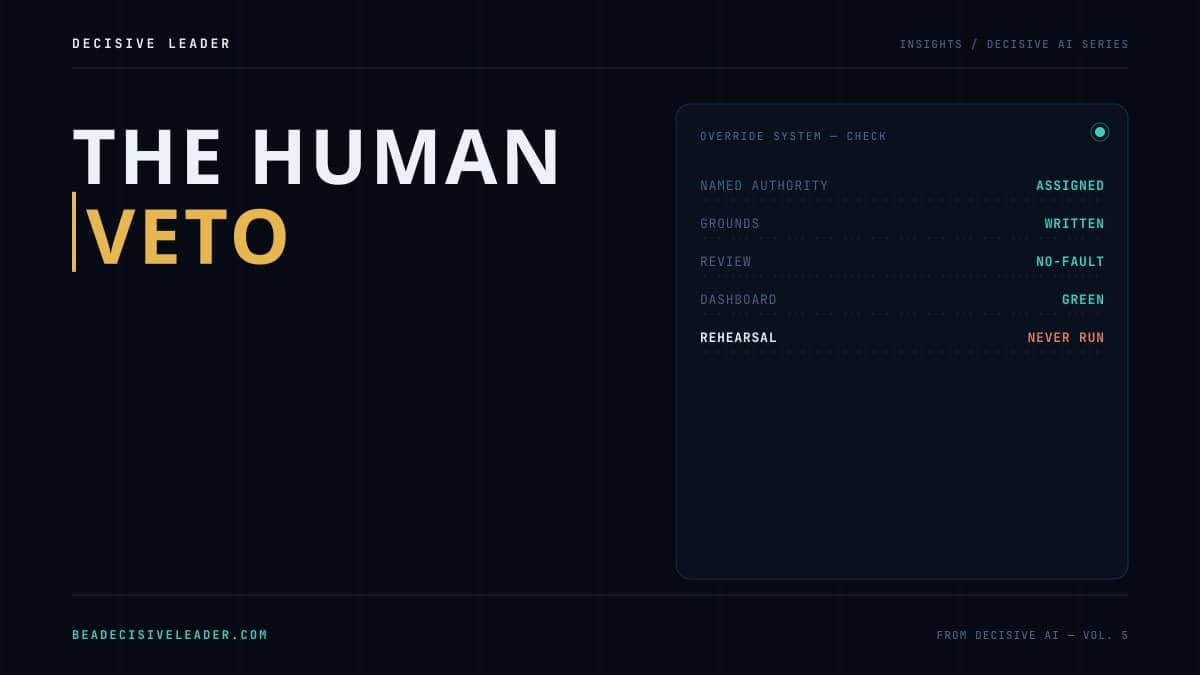
A functional Human Veto has four parts. Miss any one and you don't have a veto — you have a suggestion box.
1. Named authority. Specific roles, by name, who can override the system in their domain. "Anyone can raise concerns" is not a veto. Everyone's authority is no one's authority.
2. Defined grounds. The veto isn't "I don't like the robot." Legitimate grounds include: the model is operating outside conditions it was trained for; ground truth contradicts the output (Walt's eyes); a human-only value is implicated; the decision affects a person in a way the data can't represent. Write the grounds down. They protect the vetoer as much as the system.
3. A no-fault review. Every veto gets reviewed afterward — for learning, never punishment. If the veto was right, the model or its boundaries need fixing. If the veto was wrong, the human got a free education and the system got a data point. Either way the organization wins. The moment a wrong veto damages someone's career, you will never see another veto again. You'll just see Walts, all the way down.
4. Rehearsal. The one nobody does, and the one that matters most. A veto that has never been practiced will not survive contact with a live incident, peer pressure, and a green dashboard. Run drills. Inject a bad recommendation on purpose and see if anyone catches it and pulls the cord. In the Army, we don't hand someone a radio and assume they'll perform a medevac call under fire because the procedure exists in a binder. We rehearse until the action is muscle memory.
Maria pulls the cord
Eight months into the AI rollout in Decisive AI, a junior analyst named Maria reviews the model's renewal-pricing recommendations and stops on one: a steep increase for a mid-sized client, mathematically justified by usage patterns. But Maria knows something the model doesn't — she took the client's panicked call three weeks earlier. They just lost their biggest customer. The usage drop isn't a pricing signal. It's a distress signal.
The old Maria would have hesitated. The model had been right about pricing roughly a thousand times in a row. But Maria's name is on the veto list. The grounds are written down — "ground truth contradicts the model's inputs" is ground number two. And her team rehearsed this exact motion in a drill two months earlier.
She pulls the cord. Pricing holds, with a note. The client survives the year, remembers who didn't kick them while they were down, and triples their contract eighteen months later.
In the no-fault review, Maria is asked what made the override easy. Her answer belongs on the wall of every office deploying AI anywhere:
"It wasn't easy. It was rehearsed. Those aren't the same thing."
One staff meeting, or one recall
In the military, we brief commander's intent — the why behind the plan — precisely so subordinates can deviate when reality demands it. Give your people the same license with the machine. Make sure they know the intent behind every automated system, so they recognize the moment the system stops serving it. And make sure, beyond any doubt, that deviation in service of intent will be defended from the highest level.
That assurance costs you one staff meeting. Its absence cost Walt's company a recall.
The complete Human Veto Checklist — plus the drill design — is in Decisive AI, Vol. 5 of the Decisive Edge series. Get the books → Auditing your AI estate first? Start with the Tactical AI Audit.
Join The Bridge for one deployable protocol every Friday. Follow Decisive Leader on LinkedIn.
Was this piece useful?
Related dispatches
Next steps
Continue with what fits this essay
- ModelExplore the Four Surrenders modelFour Surrenders are four failure modes where smart teams quietly offload judgment to machines: treating model output as Continue →
- ToolApply with an ToolInteractive worksheet or diagnostic from this topic.Continue →
- CollaborateSpeaking & PartnershipsWhen governance rollout needs facilitated alignment across legal, engineering, and business.Continue →