Career pillar
AI Won't Replace What Makes Us Human
AI can draft and accelerate—but capability is not humanity. Winners use machines for speed and keep judgment, empathy, and creativity.
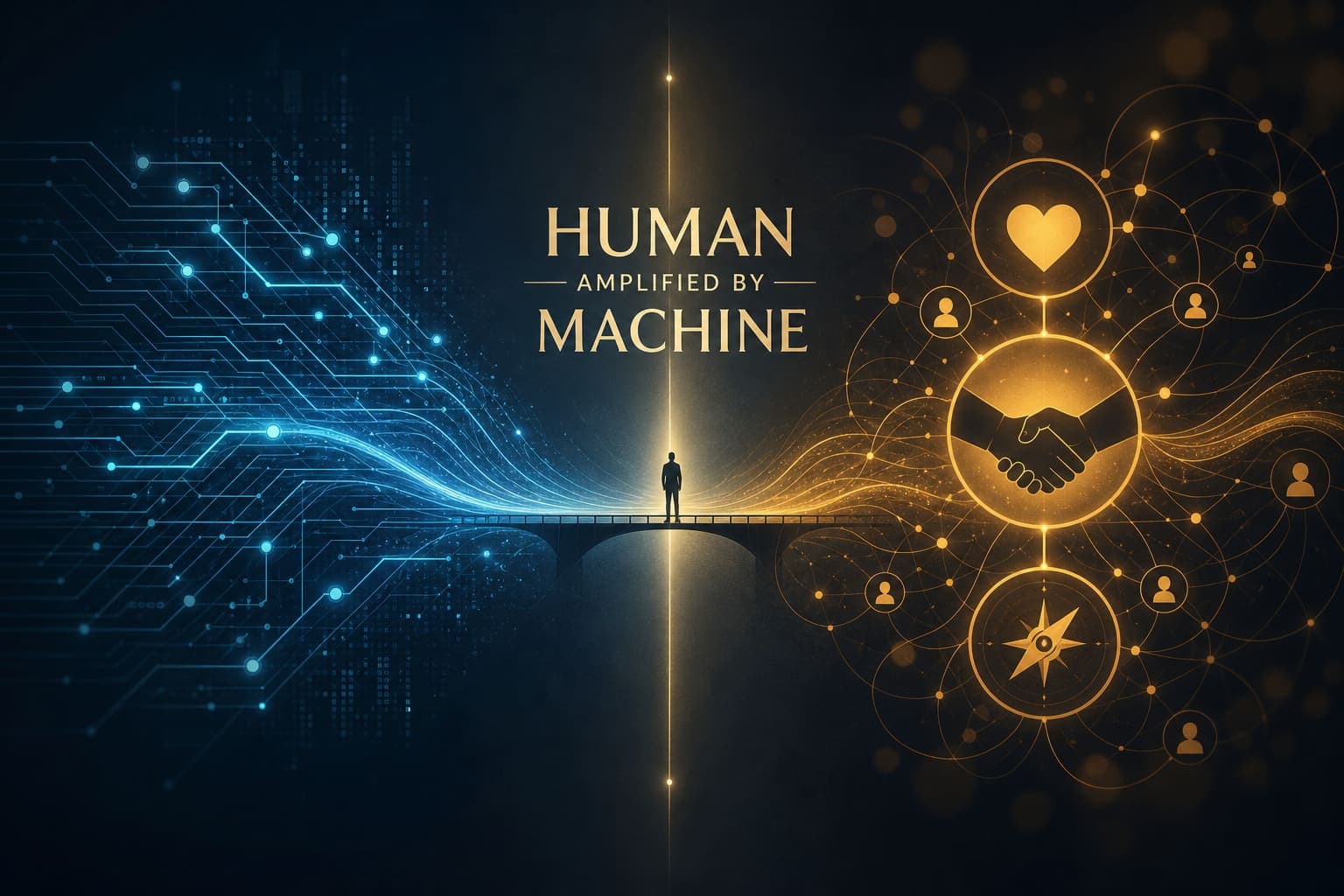
Caption: AI can move faster. Humans still decide where to go—and who needs grace on the way.
Like many leaders, I have spent the last few years exploring how artificial intelligence can help me work smarter.
I use AI to organize thoughts, summarize information, draft content, identify patterns, and accelerate tasks that used to consume hours. The productivity gains are real. Anyone who ignores that potential is likely missing an opportunity.
But the more I use AI, the more convinced I become of something else:
The future is not about AI replacing humans.
It is about freeing humans to do what only humans can do.
Capability is not humanity
People debate whether AI will replace leaders, writers, teachers, project managers, analysts, and countless other professions. The conversation focuses on capability.
Can AI write? Yes.
Can AI analyze data? Absolutely.
Can AI create presentations, plans, and recommendations? Every day.
Capability and humanity are not the same thing.
I have led teams, managed complex programs, navigated uncertainty, and worked through problems where there was no playbook. In those moments, the answer rarely came from processing information alone. The answer came from understanding people.
- Recognizing frustration before someone voiced it.
- Sensing when a team was burned out despite metrics looking healthy.
- Knowing when to push harder—and when to show compassion.
No algorithm fully understands the emotional context that surrounds every human decision.
As leaders, we often face situations where the data points one way and experience points another. The spreadsheet says the decision is logical; instinct says a bigger story is unfolding beneath the surface.
Connecting facts with emotion is uniquely human.
That tension shows up in enterprise work too: AI multiplies throughput, but organizations that only reinvest savings in coordination theater still lose the judgment layer. Speed without direction is just Decision Debt with better tools.
Creativity beyond generation
Another human advantage is creativity—not only generating words or images, but creativity born from lived experience: failures, relationships, setbacks, unexpected connections.
Some of the best ideas I have seen did not come from following a process. They came from someone asking a question nobody else considered. They came from challenging assumptions. They came from seeing a possibility that was not obvious.
AI identifies patterns from the past.
Humans imagine possibilities that do not exist yet.
That is a profound difference.
Empathy is more than language
AI can recognize emotional language. It can simulate compassion. It can generate responses that sound caring.
But empathy is more than language.
- Sitting across from someone who is struggling and understanding what they are not saying.
- Knowing when a team member needs encouragement instead of criticism.
- Extending grace when circumstances demand it.
- Choosing mercy when efficiency would be easier.
Those are not data problems. They are human problems.
In the age of AI, relationship architecture and executive composure under stakes matter more—not less. Machines run the engine; leaders still provide steering when the room is afraid.
Human amplified by machine
As AI becomes more capable, our greatest advantage will not be competing with machines. It will be embracing what machines cannot truly possess:
Curiosity. Compassion. Judgment. Creativity. Resilience. Connection.
The leaders who thrive will not reject the technology. They will use it effectively while remaining deeply human.
Machine strength
Human strength
Machine strength
Human strength
Machine strength
Human strength
Machine strength
Human strength
| Machine strength | Human strength |
|---|---|
| Speed, scale, pattern recall | Meaning, stakes, moral weight |
| Drafts and summaries | Questions that reframe the problem |
| Options from the past | Possibilities that do not exist yet |
| Simulated tone | Mercy when efficiency would be easier |
AI can help us move faster.
Humans determine where we should go.
AI can provide information.
Humans provide meaning.
AI can generate answers.
Humans ask the questions that matter.
The future belongs to those who understand both.
Not human versus machine.
Human amplified by machine.
In that future, emotion, creativity, and our ability to connect may become more valuable than ever.
One action
Pick one decision this week where the data is clean but the room feels wrong. Before you close it in a forum or email, ask one human question you would not delegate to a model: What is nobody saying, and what would grace look like here?
The audit question
When did you last change a call because of people, not pixels—and were you glad you did?
Run it: AI Governance Audit (where machines belong—and where humans must stay in charge) · Leadership Assessment · EDGE Framework PDF
Related: Sovereign professional & the AI paradox · Shadow AI governance · Leading is not scheduling (TPM vs PM)
Was this piece useful?
Related dispatches
Next steps
Continue with what fits this essay
- ModelExplore the Four Surrenders modelFour Surrenders are four failure modes where smart teams quietly offload judgment to machines: treating model output as Continue →
- ToolApply with an ToolInteractive worksheet or diagnostic from this topic.Continue →
- CollaborateSpeaking & PartnershipsWhen governance rollout needs facilitated alignment across legal, engineering, and business.Continue →