Part of a series
Decisive AI & Governance
“The machines have the answers. You have the call.”
Career pillar
Decision Debt 2.0: AI Just Opened Two New Lines of Credit
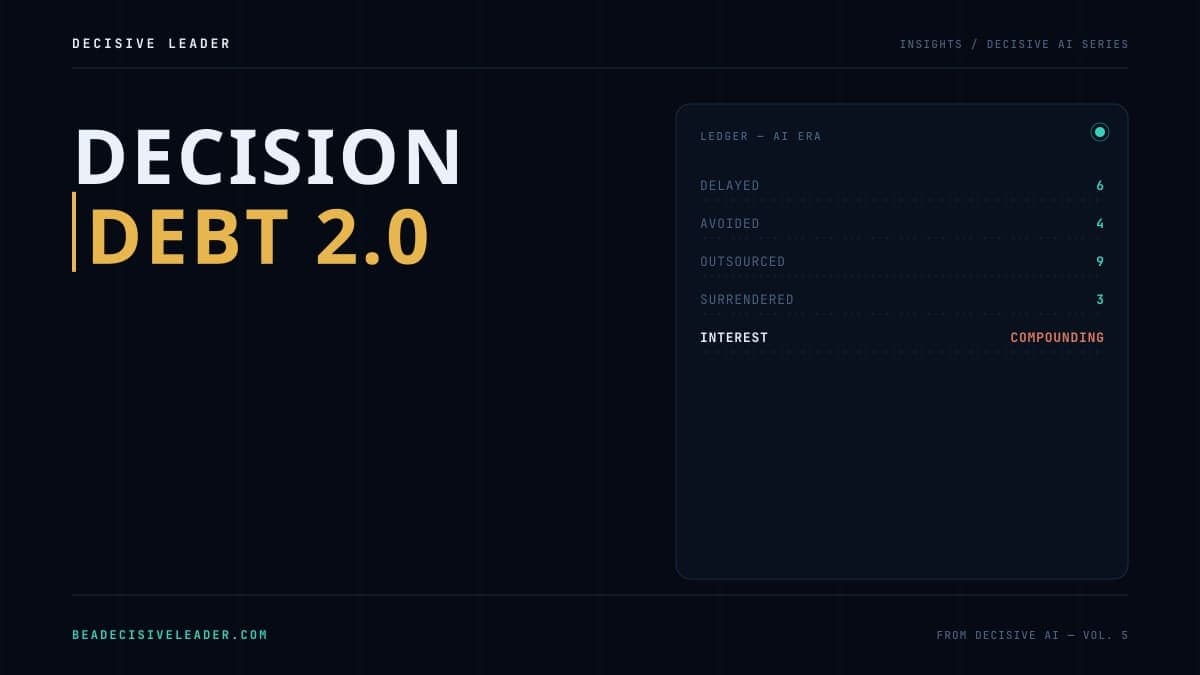
Decision Debt used to accumulate two ways: delay and avoid. AI added two new accounts — outsource and surrender — and the credit limit is terrifying.
If you've read the original Decision Debt essay — or Vol. 1 of the Decisive Edge series — you know the definition: every time you delay a difficult choice to avoid temporary discomfort, you take out a high-interest loan against your future. It compounds. Eventually your options disappear and circumstances make the decision for you.
That definition still holds. But the world changed, and the ledger needs an update.
The two classic accounts
Decision Debt always had two ways to borrow: delay and avoid. Both are as old as humanity. Somewhere in prehistory, a caveman looked at the darkening sky, thought "we should probably talk about moving before winter," and decided to bring it up at next week's fire. We've been that guy ever since.
The two new accounts
AI opened two new lines of credit: outsourcing and surrendering.
Outsourcing is when you hand a judgment call to the machine and keep the receipt. You still technically own the decision — but you didn't really make it. You forwarded the recommendation. You approved the output. You "aligned with the analysis." If your boss asked you to defend the call from a blank whiteboard, you'd be in trouble. But the model was 94% confident, so you felt 94% covered.
Surrendering is the deeper cut. It's when the decision stops feeling like yours at all. "The algorithm decided." "The system flagged it." "The model recommended against it." Notice what's missing from all three sentences: a human being. Surrendering is outsourcing with the receipt thrown away.
Here's the updated definition:
Decision Debt accumulates whenever individuals or organizations delay, avoid, outsource, or surrender decisions that require human judgment.
Same compounding interest. Same brutal collections department. Two new ways to dig the hole — and the new shovels are motorized.
Why the interest rate just went up
AI-era Decision Debt is more dangerous than the classic version for one reason: the consequences arrive faster.
When information moved at the speed of meetings, indecision was expensive but slow. You could drift for a year before the bill came due. Today your competitors operate at machine speed. While your team schedules a follow-up to discuss the analysis of the recommendation about the forecast, someone else has already shipped, learned, and shipped again.
There's a cruel irony here. The very tools that should make us faster often make us slower, because they remove the deadline that scarcity used to impose. When one more report took three weeks to produce, at some point you ran out of reports and had to decide. Now one more report takes eleven seconds. The well never runs dry — so some leaders never stop drinking.
I've watched organizations spend more time deciding how to use the decision-support tool than they spend deciding anything with it. That's not transformation. That's procrastination with a software license.
The withdrawal slips
Watch for these. Each one is a transaction on the new accounts:
- A leader forwards a model's recommendation without reading it. Withdrawal.
- A team says "let's see what the AI thinks" before anyone in the room states a position. Withdrawal.
- "The algorithm decided" replaces "I decided." That's not a withdrawal. That's surrendering the whole account.
AI did not create Decision Debt. Humans have always struggled with hard decisions. What AI did is increase both the speed and the consequences. Used wisely, it can help you pay down Decision Debt faster than any tool ever invented. Used poorly, it's the greatest debt accelerator in history.
Same tool. Different driver. The difference is you.
Size your balance
You can't pay down debt you haven't measured. Start with the Leadership Assessment — seven questions, instant read. Then find out how you're borrowing with the Four Surrenders Diagnostic.
The full Decision Debt Audit — four movements, ninety minutes, brutal honesty required — is in Decisive AI, Vol. 5 of the Decisive Edge series. Get the books →
Every Friday, The Bridge analyzes 3 operational failures and deploys 2 protocols against them — in under 4 minutes. Follow Decisive Leader on LinkedIn.
Was this piece useful?
Related dispatches
Next steps
Continue with what fits this essay
- ToolTry the Decision Debt appCapture unresolved decisions and follow through on your phone.Continue →
- ModelExplore the Decision Debt modelThe compounding cost of decisions delayed, avoided, outsourced, or surrendered: a high-interest loan against the future.Continue →
- ToolApply with an ToolInteractive worksheet or diagnostic from this topic.Continue →