Career pillar
The Brilliant Jerk Is Running Out of Leverage
AI is making specialized knowledge easier to acquire and transfer. Deep expertise still matters, but collaboration, trust, communication, humility, and people.
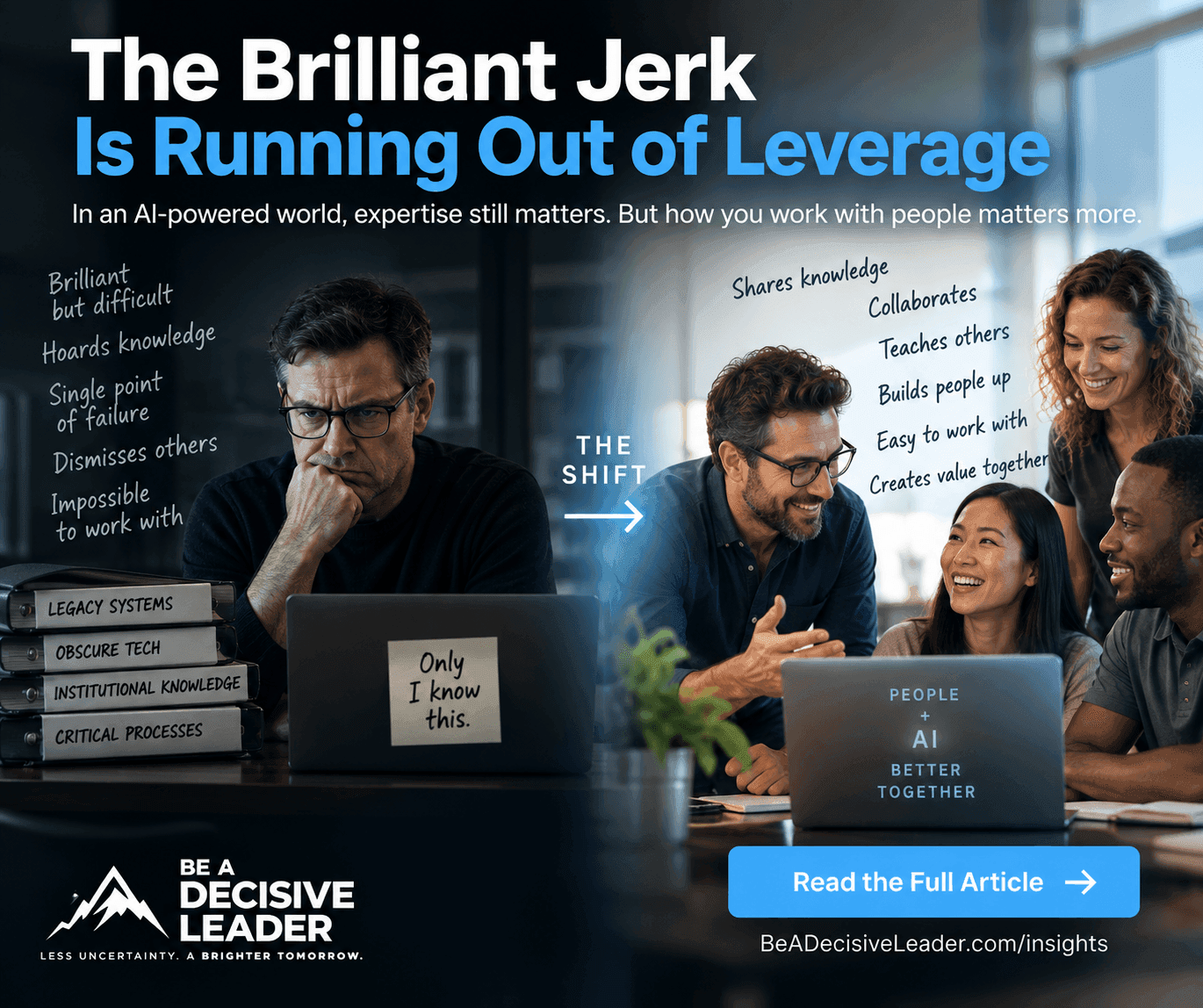
Most of us have worked with this person. They know the system. Maybe it is an old platform nobody else understands, a specialized technology, a complicated architecture, an obscure business process, or twenty years of institutional knowledge that somehow lives entirely inside one person's head. They are brilliant. They are also a complete pain in the ass to work with. They dismiss questions, talk down to people, hoard knowledge, and somehow turn every meeting into another opportunity to remind everyone that they are the smartest person in the room.
Organizations have tolerated this behavior for years because somewhere along the way, that person became indispensable. I wrote before about what I called the end of the era of the jerk, and the more I work with AI, the more convinced I am that this era really is ending. That does not mean expertise is going away. Far from it. If you really know your field, that still matters. Experience matters. Context matters. Judgment matters. What is changing is the advantage you get from being the only person who knows something.
AI is making knowledge easier to find, understand, document, and transfer. If I encounter a technology I have never worked with before, I can get up to speed dramatically faster than I could a few years ago. I can have AI explain the code, walk me through the architecture, help me understand terminology, and even create documentation that should have existed five years ago. Yes, I said it. Documentation. Developers everywhere just felt a disturbance in the Force.
That changes things. Being the only person who understands something is not the career moat it used to be, and frankly, I think that is healthy. Being a single point of failure was never a sign of organizational strength. It was a risk we occasionally confused with job security.
When Smart People Get in Their Own Way
I am watching another version of this problem play out right now. I work with two teams filled with very intelligent people. Both teams know their fields. Both have legitimate expertise, and I would happily put experts from either team in front of a difficult problem in their domain. You would think that would make collaboration easy. It doesn't.
Neither side particularly wants to acknowledge that the other side might know its own field better. Pride gets involved, and expertise starts becoming territory. Instead of saying, "You know this part better than we do. We know this part better than you do. Let's figure out where the lines are," each side starts wandering into the other's lane.
AI makes that incredibly easy. If one team needs something from the other team's domain, they no longer necessarily have to ask. They can ask AI instead. Don't understand the other team's technology? Have AI explain it. Need to build something that normally belongs on their side? AI can probably help with that too. Sometimes it even works, which is where things get interesting.
AI can make a smart person competent enough in somebody else's field to become dangerous.
The output looks good. The explanation sounds convincing. Everyone feels pretty smart. Then something breaks. Now the original team looks at what happened and says, "See? They have no idea what they're doing." The other team responds by doing even more on its own. Trust gets worse, communication gets worse, and the teams move farther apart. Before long, you have two groups of intelligent people using some of the most advanced technology ever created to avoid talking to each other.
Progress.
The irony is that AI did not create the problem. Pride did. AI just gave both sides a much more powerful way to work around each other.
AI Does Not Make You an Expert in Everything
This is something I think we need to be careful about as AI gets better. AI can make us dramatically more capable outside our primary fields, and that is one of the things I love about it. A program leader can understand code better. A developer can explore cybersecurity concepts. A security professional can understand application architecture. A business leader can analyze data without waiting three weeks for someone to build a report. These are all good things.
There is still a huge difference between understanding another field better and suddenly having twenty years of experience in it. AI can help close a knowledge gap. It cannot magically give you the experience that comes from having made mistakes in that field for twenty years. Those scars count for something.
Sometimes the smartest use of AI is not using it to replace the expert. It is using AI to understand enough that you can have a much better conversation with the expert. Maybe you can ask a better question. Maybe you can challenge an assumption you would not have understood before. Maybe you can communicate across two disciplines that traditionally struggled to understand each other. That is AI making collaboration better. Using AI because you would rather avoid talking to the person who actually knows the subject is something else entirely.
Somebody Needs to Draw the Lines
The situation with these two teams does not require another AI tool. It requires a conversation.
In the military, we talk about left and right limits. You make the boundaries clear so everyone understands where they can operate and where someone else's responsibility begins. Businesses have plenty of ways to accomplish the same thing. Use a RACI. Define decision rights. Create a responsibility matrix. Document the interfaces between teams. Draw it on a whiteboard if you have to. I really don't care what you call it.
What matters is getting everyone in a room and answering some basic questions. What does Team A own? What does Team B own? What can each team do independently? What requires consultation? What requires agreement? Who gets the final call when responsibilities overlap? When does one team need to stop and bring in the other?
This is not revolutionary management theory. It is adults agreeing on who does what.
The difficult part is that everyone has to check their ego at the door long enough to admit something uncomfortable: someone else knows more than you do about some things. That's okay. That's why we have teams. If everyone knew everything, we could save a fortune on org charts.
If the two teams I am watching simply acknowledged each other's expertise, established their left and right limits, and agreed on how work crosses those boundaries, I believe most of the conflict would disappear. AI could then become what it should be: something that makes both teams better instead of something each side uses to prove it does not need the other.
The Brilliant Jerk Has a Bigger Problem Now
For years, organizations made an implicit trade. "Yeah, he's impossible to deal with, but nobody else understands the platform." Or, "She's awful in meetings, but we can't afford to lose what she knows." AI makes that trade less attractive because if knowledge becomes easier to acquire and transfer, other things become more valuable.
Can you explain what you know? Can you teach someone? Can you listen? Can you disagree without making everyone miserable? Can you recognize when somebody else is the expert? Can you admit when you don't know something? Can people trust you? Do people actually want you in the room?
We call these "soft skills," which has always struck me as a strange name for skills that determine whether anyone wants to work with you. They aren't soft. They are career skills, and I think AI is going to make them more valuable.
If someone asked me today what skills they should be developing, I would not tell them to choose between technical skills and people skills. Learn both. Learn AI and really understand what it can do. Use it to research, analyze, build, communicate, automate, and accelerate your work. At the same time, continue building real expertise. Knowing how to type a great prompt does not suddenly make you a cybersecurity architect, attorney, actuary, software engineer, or whatever profession you decided to become Tuesday afternoon.
Then spend just as much time getting better with people. Learn to communicate and listen. Learn to explain complicated things without making the other person feel stupid. Learn to disagree without turning every conversation into a cage match. Learn to give other people credit. Learn to recognize expertise that isn't yours. Learn to make the people around you better.
AI can help someone else learn your technology. It cannot make your coworkers enjoy dealing with you.
Leaders Need to Stop Rewarding This Too
There is a leadership lesson here as well. If one person is the only human being who understands a critical system, stop celebrating how indispensable that person is and fix the dependency. Document the system. Cross train people. Create redundancy. Use AI to accelerate the knowledge transfer.
The same applies at the team level. If two teams keep doing each other's jobs because nobody can agree where the responsibilities sit, stop admiring the heroics required to clean up the resulting mess. Fix the operating model. Define the boundaries and decision rights. Agree on who owns what, and then let the experts actually be experts.
AI should make collaboration between specialties better. It should not become the weapon each side uses to prove it never needed the other side in the first place.
The strongest expert in an organization should not be the person everyone is terrified to lose. It should be the person whose presence makes everyone around them better. That is a much more valuable kind of expertise.
What AI Won't Do for You
AI is going to make a lot of technical work easier. Information will become easier to find. Unfamiliar fields will become easier to understand. Some specialized knowledge will become less scarce. That does not make people less important. I think it makes how you work with people more important.
There will always be someone smarter than you. There will increasingly be machines capable of doing things you once thought made you uniquely valuable. And there will always be someone sitting across the table who knows something you don't.
Don't use AI to prove you don't need that person. Bring your expertise. Let them bring theirs. Figure out the boundaries. Then use AI to make both of you better.
Learn AI. Build real expertise. Develop your social skills. Respect other people's expertise. And lose the smugness.
Because being the smartest jerk in the room is becoming a much less impressive business model.
And I don't think many of us are going to miss it.
Was this piece useful?
Related dispatches
Next steps