Career pillar
Is AI Breaking the Job Market—or Exposing a Hiring System That Was Already Broken?
AI is making hiring faster for candidates and employers. But is it improving hiring decisions—or simply increasing application volume, screening, and noise?
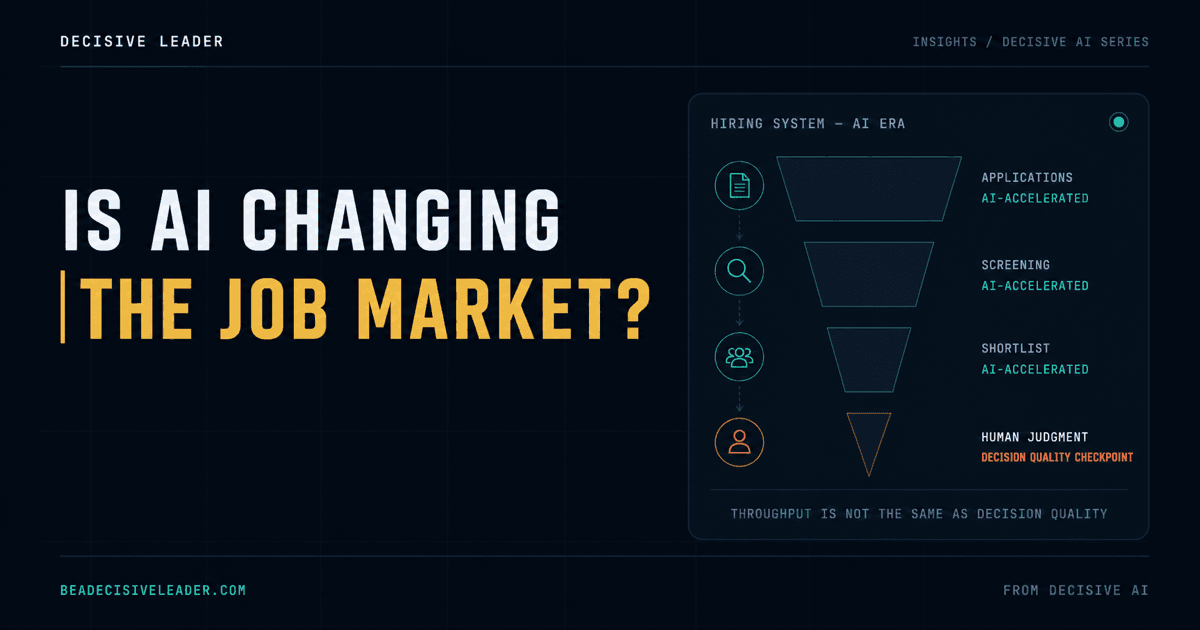
AI is changing hiring from both directions.
Candidates can use it to find jobs, tailor resumes, draft cover letters, prepare for interviews, research companies, and apply to more positions in less time.
Employers are using automation and AI too—to source candidates, screen applications, rank potential matches, administer assessments, schedule interviews, and manage enormous applicant pools.
In theory, this should produce a better hiring market.
Candidates find better-fitting opportunities. Employers identify stronger candidates. Recruiters spend less time processing applications. Decisions happen faster.
But there is another possibility:
We may be making hiring more efficient without making hiring decisions any better.
When more efficiency creates more noise
Consider what happens when the cost of applying for a job falls dramatically.
A candidate who once had time to thoughtfully pursue five opportunities might now pursue twenty. AI can customize each resume, generate a cover letter, identify relevant keywords, and prepare the candidate for screening questions.
That's useful for the candidate.
Multiply it across thousands of candidates, however, and employers face a different problem: volume.
More applications create pressure for more automated screening.
That screening then changes candidate behavior. Applicants learn to optimize resumes for applicant-tracking systems and AI screening tools. AI becomes useful for that too.
Employers improve their filters.
Candidates improve their optimization.
And an interesting cycle begins:
More AI → more applications → more screening → more optimization → more automation.
Everyone gets faster.
But is the decision getting better?
(On the candidate side of that loop, judgment still matters more than volume—see AI Won't Get You the Job. Your Judgment Will..)
Hiring is a judgment, not a processing problem
At its core, hiring isn't about processing resumes.
It's a decision:
Is this the right person for this role, this team, and this organization?
A resume provides evidence for that decision. So does an interview, someone's work history, references, demonstrated skills, and perhaps an assessment.
None of those things is the decision.
This distinction matters because organizations frequently optimize what is easiest to measure:
- Time to screen
- Time to interview
- Time to hire
- Number of applicants
- Cost per hire
Those are useful operational measures.
But an extraordinarily efficient process can still produce a poor decision.
That is where this becomes a Decision Debt problem.
Decision Debt in hiring
Decision Debt accumulates whenever individuals or organizations delay, avoid, outsource, or surrender decisions that require human judgment. In hiring, that often shows up as unresolved, poorly owned, repeatedly reopened, or weakly structured calls that create downstream cost.
Hiring can produce its own version.
If an organization isn't clear about what it actually needs, AI won't solve that ambiguity.
If hiring managers disagree about what makes someone qualified, faster screening won't resolve it.
If job descriptions contain every capability someone might conceivably want rather than the capabilities actually required, better matching technology may simply automate against a bad specification.
And if organizations become overwhelmed by applications, increasingly aggressive filtering may remove candidates who deserved human consideration—the same failure mode that shows up when automated systems ship without a designed Human Veto.
The technology may be working exactly as designed.
The decision system surrounding it may be the problem.
Maybe AI isn't the villain
There is an important counterargument.
Perhaps AI isn't breaking hiring at all.
Hiring has always had imperfect job descriptions, keyword screening, networking advantages, overwhelmed recruiters, inconsistent interviews, unconscious biases, and candidates trying to present themselves in the best possible light.
AI may simply be making those weaknesses more visible.
That's why declaring AI either the problem or the solution misses the more interesting question.
What should AI actually do in a hiring decision?
It should probably help people find relevant information.
It can surface candidates humans might overlook.
It can organize evidence.
It can reduce administrative work.
It can identify inconsistencies.
It can help recruiters manage scale.
But we should be careful about confusing those capabilities with judgment—the same line that runs through Four Surrenders and Decisive AI: accelerate the work that should be accelerated; keep human ownership where the call matters.
The objective shouldn't be to automate as much of hiring as possible.
The objective should be to make better hiring decisions.
The question leaders should be asking
Organizations adopting AI into hiring should ask something more difficult than:
"Where can we automate?"
They should ask:
Where does AI improve the quality of the decision, and where does it merely increase the speed at which we process it?
Those aren't the same thing.
Candidates aren't going to stop using AI.
Employers aren't going to stop using it either.
The challenge now is designing a hiring system in which increasingly capable technology produces better signal rather than simply more volume.
Because processing 1,000 candidates efficiently isn't necessarily progress.
Choosing the right one is.
Better Decisions. Less Decision Debt.
Was this piece useful?
Related dispatches
Next steps
Continue with what fits this essay
- EDGE ToolTry the Decision Debt appCapture unresolved decisions and follow through on your phone.Continue →
- ModelExplore the Decision Debt modelThe compounding cost of decisions delayed, avoided, outsourced, or surrendered: a high-interest loan against the future.Continue →
- EDGE ToolApply with an EDGE ToolInteractive worksheet or diagnostic from this topic.Continue →